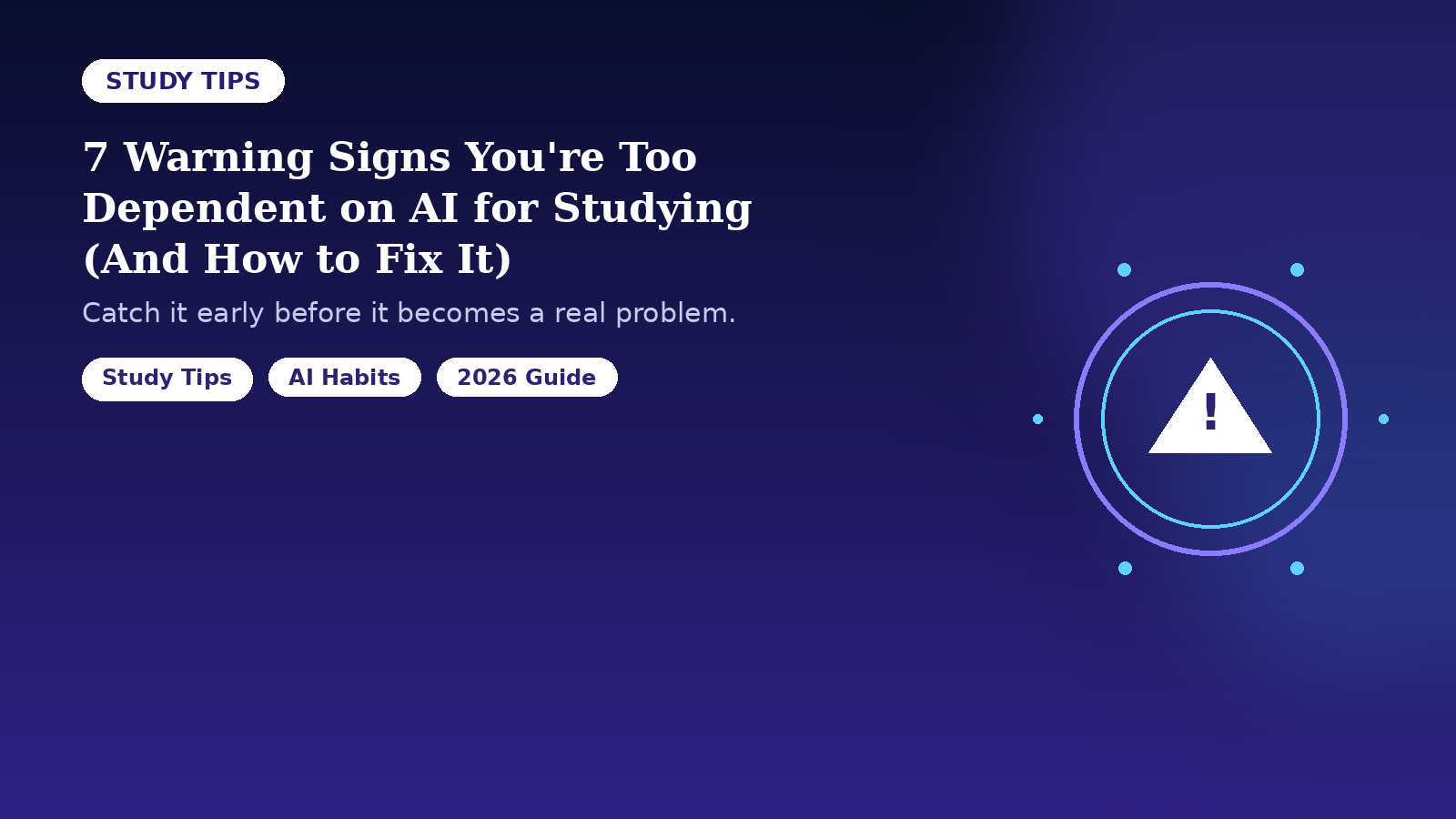
Signs you’re becoming too dependent on AI for studying can be sneaky, and here’s exactly how one of my friends found out the hard way. She sat down for a closed-book quiz and genuinely panicked. Not because the material was hard. Because for the first time in months, there was no chat window to lean on, and she wasn’t sure her brain still remembered how to do this alone. Not because the material was hard. Because for the first time in months, there was no chat window to lean on, and she wasn’t sure her brain still remembered how to do this alone.
She wasn’t lazy. She wasn’t cheating. She’d just slowly slid from using AI as a tool into using it as a crutch, one convenient shortcut at a time, without ever noticing the line she crossed.
That’s how dependency usually happens. Not in one obvious moment, but gradually enough that you don’t catch it until a test forces you to.
Here are seven signs it might be happening to you, and what actually helps.
Sign 1: You Can’t Start an Assignment Without Opening AI First
If the very first move for every essay, problem set, or discussion post is opening a chat window before you’ve even thought about the topic yourself, that’s worth noticing. There’s nothing wrong with using AI to brainstorm. The problem is when it’s become the only way you know how to begin.
The fix: Force yourself to write down three sentences of your own thinking before you open any AI tool. Even bad, messy sentences. This keeps the starting muscle from atrophying completely.
Sign 2: You Accept the First Answer Without Reading It Critically
Early on, most people read AI responses carefully, checking whether they actually make sense. Dependency often shows up as a shift toward skimming, copying the gist, and moving on, without really evaluating whether the explanation is even right.
The fix: Before you use any AI-generated explanation, ask yourself if you could explain it back in your own words without looking. If you can’t, you haven’t actually understood it, you’ve just borrowed it.
Sign 3: Signs You’re Becoming Too Dependent on AI: Sign 3
This is the big one, and it’s exactly what happened to my friend. If the thought of an in-person exam, a pop quiz, or any moment without AI access triggers real anxiety rather than normal exam nerves, that’s a strong signal your studying has been outsourced more than you realized.
The fix: Practice retrieval on purpose. Close every tab, put your notes away, and try to reconstruct what you learned from memory. It’ll feel harder than reading a summary. That difficulty is the point, it’s literally what builds retention.
Sign 4: You’ve Stopped Reading the Full Explanation
A subtle one. You ask AI something, skim the first two lines, get the gist, and move on without reading the rest. Over time, this trains you to grab surface-level answers instead of building actual depth on a topic.
The fix: Pick one AI response a day and actually read it end to end, then ask a follow-up question that pushes past the surface level. This keeps the habit of genuine engagement alive instead of letting it quietly disappear.
Sign 5: You Can’t Remember What You “Learned” Yesterday
This is one of the clearest signs you’re becoming too dependent on AI without even realizing it. If you asked AI to explain something yesterday, felt like you understood it in the moment, and today you can’t reconstruct even the basic shape of it, that’s a red flag. Understanding something while reading it and actually retaining it are two very different things, and AI dependency tends to blur that difference.
The fix: End each study session by closing everything and writing a short summary from memory of what you covered. If the page comes out mostly blank, that topic needs a real review, not another AI explanation.
Sign 6: You Feel Lost the Moment a Question Is Phrased Differently
This shows up hard during actual exams. You understood the concept when AI explained it one specific way, but the second a question asks about it from a different angle, you’re stuck. That’s a sign you memorized a specific explanation rather than understanding the underlying idea.
The fix: After AI explains something, ask it to rephrase the same concept two more ways, or better yet, try explaining it yourself in a completely different way. If you can only recognize one version of an idea, you don’t own it yet.
Sign 7: You Feel Guilty or Defensive When Someone Asks How You Studied
Understanding signs you’re becoming too dependent on AI often starts with noticing your own reactions. If the honest answer to “how did you prepare for this” makes you a little uncomfortable, that discomfort is data. It usually means some part of you already knows the studying was thinner than it looked.
The fix: Be honest with yourself about the ratio. If nearly every study session starts and ends with AI and almost none of it involves you working through something on your own, that ratio needs to shift, even a little.
What Healthy AI Use Actually Looks Like
None of this means quitting AI. That would be like refusing to use a calculator to prove you understand math, it doesn’t actually help and it isn’t necessary. The difference between healthy use and dependency isn’t whether you use AI, it’s whether you can still function without it if you had to. Recognizing signs you’re becoming too dependent on AI is really the first step toward fixing it.
A useful gut check: attempt something yourself first, use AI to check your work or explain what you got wrong, then try the original problem again without looking. If you can do that final step, you’re using AI as a tool. If you can’t, you’ve been leaning on it more than you realized.
Final Thought
At the end of the day, signs you’re becoming too dependent on AI are worth catching early. Nobody notices dependency building in real time, that’s exactly what makes it dependency instead of just convenience. The fix isn’t dramatic, it’s a handful of small habits: attempt first, read fully, test yourself from memory, and notice when a closed-book moment makes you more anxious than it should. Catch it early, and AI stays exactly what it’s supposed to be, a tool that makes studying faster, not a crutch that quietly replaces the studying itself.
Want to build healthier AI study habits overall? Check out our guide on 5 Mistakes Students Make When Using AI to Study.https://aiforstudy.de/5-mistakes-students-make-when-using-ai-to-study-and-how-to-fix-them/