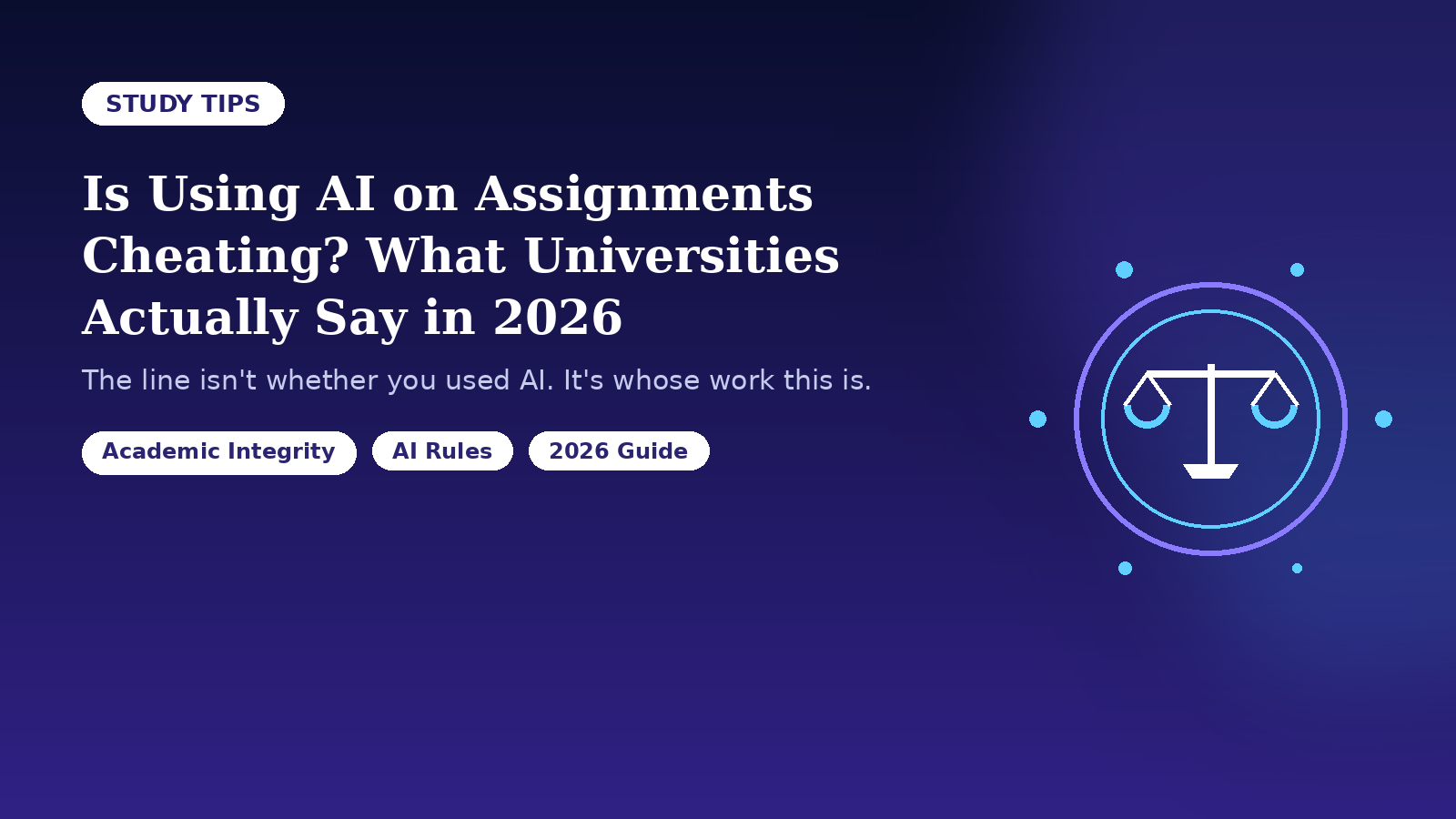
Is using AI on assignments cheating? That’s exactly what my cousin asked me last month, and I didn’t have a great answer for her right away.
She’d used ChatGPT to help outline an essay, then wrote the whole thing herself in her own words. She wanted to know if that counted as cheating. Not “will I get caught” cheating, just genuinely, is this okay.
I gave her a vague answer at the time. It bugged me enough that I actually looked into what universities are saying now. The honest answer is messier than a simple yes or no. It really depends on what you did with the AI, not just that you used it at all.
“That’s really the whole question behind is using AI on assignments cheating.”
“Is Using AI on Assignments Cheating? The Short Version”
Almost no university treats AI as universally banned anymore. Most have landed somewhere in the middle.
AI is fine as a support tool, research, brainstorming, checking your grammar. But having it write substantial parts of your actual work and submitting that as your own gets treated like any other academic dishonesty.
The line isn’t “did you touch AI.” It’s “whose work is this actually.”
That sounds simple until you try to apply it to something like my cousin’s situation, which is exactly where the confusion lives.
Why “Did You Use AI” Is the Wrong Question
A lot of students think about this as a single yes-or-no switch. Either you used AI or you didn’t, and if you did, you’re somehow in a gray zone. That’s not really how universities frame it anymore.
Asking a chatbot to explain a confusing concept before you write about it yourself is different from asking it to write the paragraph for you. Checking your grammar after writing a full draft is different from pasting the prompt in and copying the output.
Most thought-through policies draw the line around effort and ownership, not the tool itself. If the ideas, structure, and final wording are meaningfully yours, using AI somewhere in that process usually isn’t treated as misconduct. If AI produced the substance and you’re presenting it as your own thinking, that’s where it crosses over.
“This is exactly why is using AI on assignments cheating doesn’t have a simple yes or no answer.”
What Actually Gets Students in Trouble
A few specific patterns keep showing up in actual misconduct cases, pretty consistently across different schools.
Submitting AI output with little to no changes is the most obvious one. If your paragraph reads suspiciously smooth and generic because you genuinely didn’t rewrite it in your own voice, that’s the clearest case of misuse.
Fabricated citations trip people up without them even realizing it. AI tools confidently generate sources and authors that don’t exist. Skip verifying a citation, and you can submit a fabricated source without ever intending to cheat. Universities generally don’t care whether it was deliberate or just careless.
Not disclosing AI use when your school requires it is its own problem, separate from whether the content itself was fine. More schools now ask students to note where they used AI, similar to citing a source. Skipping that, even with reasonable use, can be treated as a violation on its own.
“Understanding is using AI on assignments cheating often comes down to these specific patterns.”
What Universities Are Generally Fine With
On the other end, a fairly consistent list shows up as acceptable across official guidance.
Using AI to explain a concept you’re stuck on, the way you’d use a tutor. Getting help outlining your own ideas before writing the actual content yourself. Grammar and clarity checks after your own draft is done, most schools compare this to a spell checker. Research help, like finding search terms or summarizing a paper you’re about to actually read.
The common thread: the effort and final understanding are still coming from you.
Why the Rules Aren’t the Same Everywhere
Here’s what makes this genuinely confusing. There’s no single universal policy, and there probably won’t be one soon.
Individual universities, departments, even individual professors set their own rules. A writing-heavy humanities course might restrict AI far more than a computer science course where AI-assisted coding is basically industry standard.
The honest answer to “is this okay” is: check your specific syllabus, and ask your professor when it’s unclear. That’s genuinely what academic integrity offices tell students, because a rule that works in one class can be a violation in another.
A Simple Way to Think About It
Ask yourself honestly: if my professor watched me use AI exactly this way, in real time, would they call it reasonable help, or would they think someone else did my work?
Most students already know the answer before they finish asking the question. The cases that actually cause trouble are rarely the genuinely ambiguous ones. They’re the ones where a student already suspected it wasn’t okay and did it anyway.
Final Thought
Universities that have actually thought this through aren’t trying to ban AI. They’re protecting the same thing they always have: that a grade reflects what a student actually knows.
Used as a tutor, a brainstorming partner, or a proofreader, AI fits fine within that. Used as a replacement for your own thinking and presented as yours, it doesn’t. That was true of ghostwriting long before AI existed too. The tool changed. The question universities are asking didn’t.
‘Want to make sure you’re using AI the right way? Check out our guide on How to Fact-Check AI Answers Before Submitting Your Assignment.’https://aiforstudy.de/how-to-fact-check-ai-answers/